Keep the core systems that work. Next to them we build with you what sets you apart, as your own code in your own Azure. Every app knows from day one what its data means.
It has never been cheaper to turn processes, knowledge and software into a self-learning system.
Your code, your cloudOne context metagraph across all appsMeasured in one system
launchpad · editor
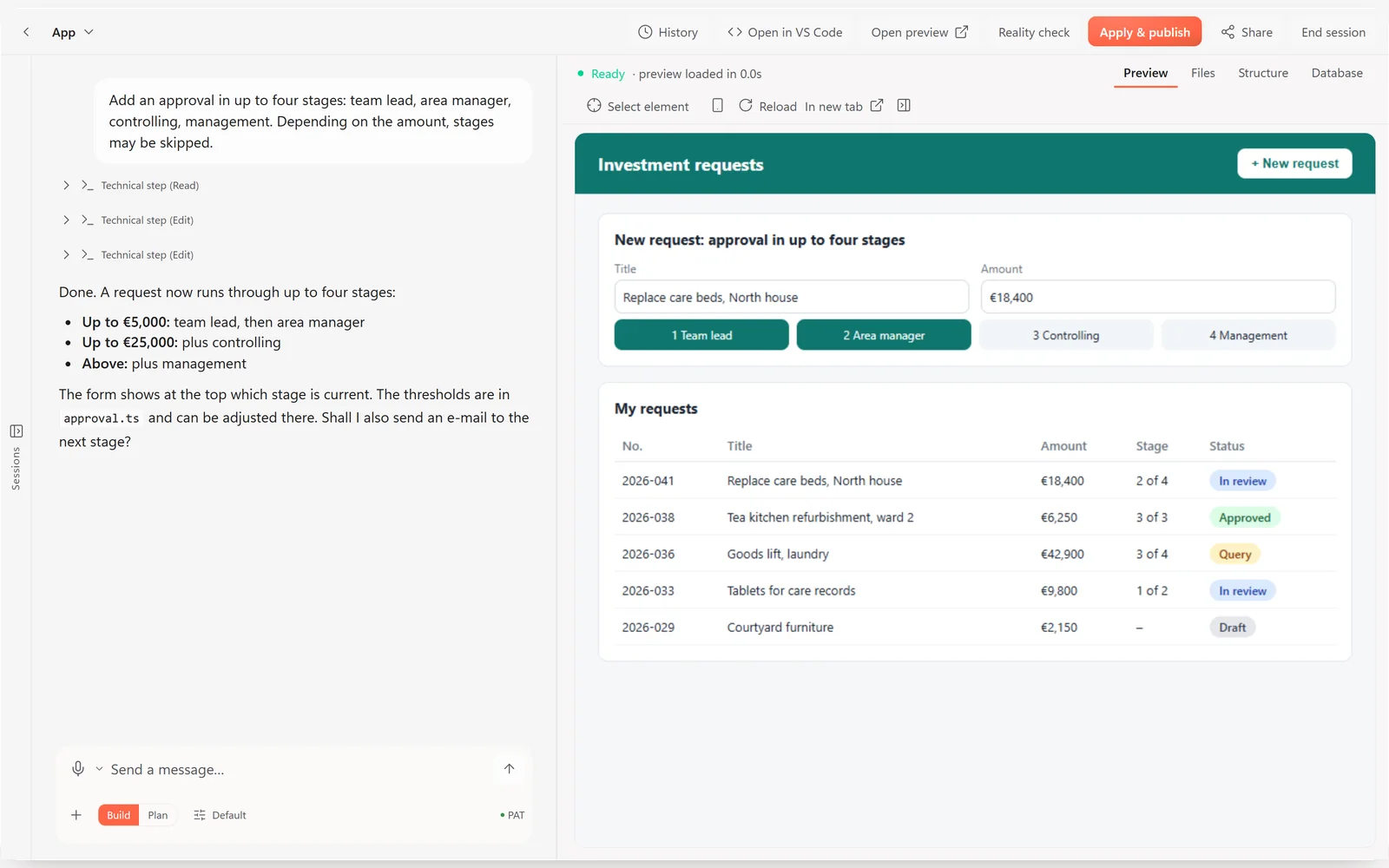
On the left you say what the app should do, on the right it runs. The real interface, example data.
Where Launchpad stands
Software becomes your system only when it knows what your data means.
The software panel asks whether you get your own app in production and who owns it. The knowledge panel asks whether the meaning of your data is captured while building and reaches all systems. The third panel combines both.
Software
↑ Ownership: with you
with the vendor
Coding assistants
Custom development
AI app builders
SaaS and low-code
AI app buildersAIappbuilderse.g. Lovable, Bolt, v0, Replit
Coding agentsCodingagentsandAIIDEse.g. Claude Code, Codex, Copilot, Cursor
Low-codeLow-codewithAIe.g. Power Apps, OutSystems, Mendix
OntologiesOntologyplatformse.g. Palantir, Fabric IQ
Business softwareBusinesssoftwarewithagentse.g. SAP, ServiceNow, Salesforce
Data catalogsDatacatalogs,semanticlayerse.g. Purview, Collibra, dbt
IT servicesITserviceproviders,classicprojectas a type
Own teamOwnteamwithAIassistants
Launchpad
PrototypeProduction readiness: production app →
+
Knowledge
↑ Origin: while building
afterwards
Data model per app
Context layer
Data silos
Data catalogs and ontologies
AI app buildersAIappbuilderse.g. Lovable, Bolt, v0, Replit
Coding agentsCodingagentsandAIIDEse.g. Claude Code, Codex, Copilot, Cursor
Low-codeLow-codewithAIe.g. Power Apps, OutSystems, Mendix
OntologiesOntologyplatformse.g. Palantir, Fabric IQ
Business softwareBusinesssoftwarewithagentse.g. SAP, ServiceNow, Salesforce
Data catalogsDatacatalogs,semanticlayerse.g. Purview, Collibra, dbt
IT servicesITserviceproviders,classicprojectas a type
Own teamOwnteamwithAIassistants
Launchpad
One appReach: all systems →
=
Software and knowledge
↑ Context: all systems
One app
Data and ontology platforms
App platform with context layer
Prototyping
Custom development and low-code
AI app buildersAIappbuilderse.g. Lovable, Bolt, v0, Replit
Coding agentsCodingagentsandAIIDEse.g. Claude Code, Codex, Copilot, Cursor
Low-codeLow-codewithAIe.g. Power Apps, OutSystems, Mendix
OntologiesOntologyplatformse.g. Palantir, Fabric IQ
Business softwareBusinesssoftwarewithagentse.g. SAP, ServiceNow, Salesforce
Data catalogsDatacatalogs,semanticlayerse.g. Purview, Collibra, dbt
IT servicesITserviceproviders,classicprojectas a type
Own teamOwnteamwithAIassistants
Launchpad
PrototypeDelivery: production app →
Examples
AI app builders (e.g. Lovable, Bolt, v0, Replit)
Coding agents and AI IDEs (e.g. Claude Code, Codex, Copilot, Cursor)
Low-code with AI (e.g. Power Apps, OutSystems, Mendix)
Ontology platforms (e.g. Palantir, Fabric IQ)
Business software with agents (e.g. SAP, ServiceNow, Salesforce)
Data catalogs, semantic layers (e.g. Purview, Collibra, dbt)
IT service providers, classic project (as a type)
Own team with AI assistants
Our own assessment from public sources, November 2026. Vendors as examples, service providers as a type. Third panel: delivery = 60 % production readiness + 40 % ownership, context = 70 % reach + 30 % origin.
How it works
Three flywheels turn it into a system that learns by itself.
The organisation works in the front ends and queries the shared knowledge of all apps (context metagraph). The agents of all apps run on one agent platform, and the apps read and write in your systems, all in your cloud. In every flywheel, a person checks before the system learns from it.
FDEs and technical support · The FDEs structure all three flywheels: Software · Knowledge · Processes
existing systems and data
infrastructure as code and DB
knowledge
apps and front ends
agents and D-personas
people, FDEs, just experts
The apps share sign-in, master data and interfaces, so no new silos appear.
D-personaA digital person per role that also acts on its own, within limits
FDEsEngineers who build with your team
AADBuilding with a coding agent, checked by gates, approved by a person
Context maturity
One score shows how far the system has come.
Context maturity has seven parts, from knowledge to agents acting within limits. It is measured every night, and what you build with AAD drives it up.
Context maturity
Example from practice
Software (AAD)
Knowledge
Processes
AAD is the means to an end: software delivers the data that drives the score towards 100 %.
The path in five steps
1Every app on its own
Starting point: each app knows only its own data
2All apps described
Every app delivers the meaning of its columns
Terms linked to open standards
3Knowledge carriesExample
Semantic coverage
Answers from the graph alone are correct
Automation maturity
4Answers carry
Assistant answers correct
Departments released for the assistant
Values without findings
Trace per answer and decision
5Agents act
D-personas per role
Acting within limits, per department
What knowledge and learning are made of
Knowledge
Coverage · weight 50
Answers · weight 30
Learning rate · weight 20
Learning in nine steps
L1 Capture
L2 Gap detection
L3 AI proposals
L4 Guardrails
L5 Human review
L6 Write-back
L7 Evals
L8 Feedback loop
L9 Discovery
Example from practice
Software (AAD)
Knowledge
Processes
AAD is the means to an end: software delivers the data that drives the score towards 100 %.
Knowledge70 % semantic coverage · weight 30
Learning91 % automation maturity · weight 20
Answers63 % correct answers per role · weight 20
Checked values15 % checked metrics · weight 10
Standards85 % linked to open standards · weight 10
Agent team6 % agents on the ladder · weight 10
Autonomyagents act within limits
The path in five steps
1Every app on its own
Starting point: each app knows only its own data
2All apps described
Every app delivers the meaning of its columns
Terms linked to open standards
3Knowledge carriesExample
Semantic coverage
Answers from the graph alone are correct
Automation maturity
4Answers carry
Assistant answers correct
Departments released for the assistant
Values without findings
Trace per answer and decision
5Agents act
D-personas per role
Acting within limits, per department
What knowledge and learning are made of
Knowledge
Coverage · weight 50
Answers · weight 30
Learning rate · weight 20
Learning in nine steps
L1 Capture
L2 Gap detection
L3 AI proposals
L4 Guardrails
L5 Human review
L6 Write-back
L7 Evals
L8 Feedback loop
L9 Discovery
Example from practice, values rounded. Measured every night.
In practice
On the way there, the organisation already works better.
A group of companies with 38 sites and highly sensitive data works with its own apps, built with Launchpad. This is a normal day there.
Building services, one of 38 sites
A fire door does not close properly. The technician takes a photo, sets the status and signs on the phone.
The inspection app replaces paper and Excel. Facility management sees for every site which protocols are still open.
Photo and status per defect
Digital signature
Open protocols across all sites
Proof for liability
Not only at this group.
Interior fit-out, mid-sizedIn production
Excel lists and island tools gave way to one data platform in the company's own Azure. The team maintains article and project numbers in one app, and every correction can be undone and stays visible.
Material master in SAP, energy groupProof of concept
Creating a new material takes days, most of it waiting. Manufacturer and part number become a complete master record, checked against the existing stock. Every company that runs SAP knows the problem.
M&A consultancyPublic demo
More than seven tools became one learning app in the firm's own tenant.
Two apps in detailTwo applications for a group of companies with 38 sitesNo standard software covers either workflow without expensive customising. The group built both apps with us and now develops them itself.+
Group of companiesBuild instead of buyBuilt with Launchpad
Request portal: the group's own application instead of customised standard software
Group of companies with 38 sites and highly sensitive data
The situation
Requests for purchases, staff, vehicles and IT run by mail, approvals come back as replies in the thread
Up to 4 approval levels depending on category, site and amount, at around 160 requests a month
What we built
A portal on Azure with its own SQL database, roles and rights through Entra ID
Approval chains by category, site and amount, with a cross-site view of everything still open
Results
1 to 2
people over a few weeks, instead of 3 to 4 over months
Hours
to change the approval logic, instead of a change request
€5,000 to €500
threshold for level 4, adjusted by the CEO personally
What we learned
Standard software maps company-specific approvals only through expensive customising
Own interfaces instead of vendor limits, and no additional SaaS licences
Group of companiesBuild instead of buyBuilt with Launchpad
Defect app: statutory inspections proven digitally and without gaps
Group of companies with 38 sites and highly sensitive data
The situation
Building technicians and facility managers keep weekly and monthly protocols for fire safety, electrics, water and building maintenance
The inspections are mandatory and the operator is liable, yet the proof was scattered and not visible across sites
What we built
A phone app with photo documentation, status tracking for every defect and a digital signature
Facility managers see across all sites which protocols are still open
Results
0
media breaks, nothing is copied from paper into Excel any more
38
sites at a glance, with open protocols and defects
4
inspection areas: fire safety, electrics, water, building maintenance
What we learned
The approach carries over to further processes
Clear responsibility per site and per protocol
Measured in one system
These apps are built faster and cheaper than ever, and we measure it.
Speed, effort and cost come straight from the pipelines and the code of the apps.
25 min
median from pull request to live; 98 % within one day
DORA elite: under one day
0.07
person-days per function point
industry average 1.5 (ISBSG)
€69–92
per function point
€635–2,320 for a team with AI assistants
A function point measures what software does for its users, independent of language and tools. “Team with AI assistants” means a good team that already codes with Copilot, Cursor or Claude.
Measured at a group of companies with 38 sites and highly sensitive data: 1,372 changes in 60 days across twelve apps, September to November 2026. Benchmarks: DORA (Accelerate State of DevOps 2024), ISBSG (2025).
What we measure for you
Build
lead time, effort and cost per function point, code churn, deployment failure rate
Run
Azure and model cost per app
Use
answers per role, tools switched off, the share you build yourself
We agree the baseline before we build, and you see the same numbers we see.
Your business case
What does that mean for your numbers?
The calculator gives a first order of magnitude. The figures only become reliable for your own workflow, with your baseline and the full costs.
Adjust your team size and SaaS spend. The numbers update instantly.
Users in the team50
10200
SaaS tools replaced
Based on Zylo SaaS Management Index 2025 (+21.9%/yr). Build cost ~€50k, ops ~€5k/yr.
Savings over 5 years — 50 users
€226,253
vs. continuing with SaaS tools
SaaS over 5 yrs€301,253
Own app over 5 yrs€75,000
Break-even
1.4 years
from day of launch
With 50 users and 4 SaaS tools replaced, your own app pays off in 1.4 years and saves €226,253 over 5 years.
Security and operations
Everything runs in your own Azure tenant and is checked on every deploy.
Your Azure tenant
Entra ID
sign-in, roles
Static Web App
user interface
API Management
every call checked
Azure Functions
logic, serverless
PostgreSQL
not open to the internet
Key Vault
secrets never in code
Azure DevOps
your repo, pipelines, IaC
Models of your choice
EU-hosted, swappable
This is what a Launchpad app looks like in your tenant.
Infrastructure as code
Every resource is defined in code and rolled out by a pipeline. Nothing is clicked together by hand.
Managed services only
Microsoft runs the Azure services. There are no containers or clusters for anyone to patch.
Zero trust
Every call is authenticated with Entra ID. Databases and backends are not open to the internet.
Models you can swap
You choose the model per task and switch when a better one comes along. Business data goes only to EU-hosted models in your Azure.
Tests and gates
Tests, data-governance and security gates on every deploy, with scheduled security scans on top.
Who builds with you
A team from just experts builds with you and stays on after go-live.
Consulting
We find the workflows worth building and set up processes and agents with your teams.
Strategy Consulting
AI-Consulting
IT-Consulting
Data Intelligence
Organizational Intelligence
Solutions
FDEs
Engineers who build with your business in the AAD loop and own architecture, quality and go-live.
Technical support
Help with the platform and every app in your tenant, from the first app to daily operation.
The team behind Launchpad has built data and BI platforms this way for years: infrastructure as code, declarative databases, everything in repositories, custom or Power BI front ends. Launchpad takes that to apps.
Talk directly to the people who build with you.
Book a meeting30 min · tailored to your use case · no commitment
AI projects usually stall on missing context. With Launchpad, getting that context takes no separate data project. Every app describes what its data means while it is built, and the deploy stops without that description. Together the apps form a context metagraph of your system landscape.
The term “facility” connects twelve apps; every dot is a data field.
Real components from the reference customer's hub, with invented data.
Your own apps
bring their meaning with them when they are built: fields, KPIs with their calculation and which app is the source of truth.
Systems you bought
get their meaning when we connect them, each field with its protection class. A gate lets no field through without a role and a protection class. That is how the fields of a documentation system our reference customer bought carry a role and a definition.
With plugnpl.ai
Through plugnpl.ai, the whole organisation works with this system.
plugnpl.ai is the AI platform for everyone in the company; Launchpad builds your own apps. Both run in your tenant and use the same knowledge of your data. Each product also works on its own.
All in your tenant · each person's rights via Entra · data in the EU only · everything measurable
plugnpl.ai asks the metagraph and uses the apps → reports what is missing in daily work, without personal data → Launchpad builds it
plugnpl.ai asks the metagraph and uses the apps
reports what is missing in daily work, without personal data
Launchpad builds it
You replace nothing before you start. What is missing in daily work gets built first.
Start with one workflow. The system grows from there.
Name one workflow your core systems don't cover well. In 30 minutes we sketch what it could look like as your own app in your tenant. We won't show slides.